Murray State University Athletics
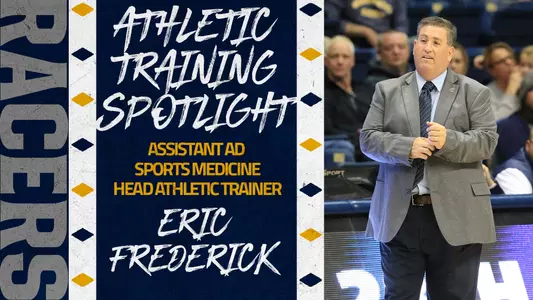
Athletic Training Spotlight: Eric Frederick
5/18/2020 6:10:00 PM | General
Eric Frederick began his journey at Murray State in September of 1993 when he started as an assistant athletic trainer in a time where the Racer athletic training staff featured a team of just two in Frederick and now MSU head rifle coach Alan Lollar. Frederick has covered the men's basketball program all 26 years, but has had the opportunity to work with all of the sports on campus - especially during those early years in the aforementioned two-person staff. A graduate of Texas Christian University, he earned his degree in physical education with an emphasis in athletic training in 1992 before going on to complete his master's in exercise physiology in 1995.
Over time, as Murray State was able add more staff and spread out the duties a bit more, Frederick became the head athletic trainer, a role he has now held for 10 years. Most recently, he was named the Assistant AD for Sports Medicine and still serves as the primary contact for men's and women's golf and men's basketball. In this week's edition of the MSU Athletic Training Spotlight, he discusses how experience has shaped his approach to the rehabilitation of injuries and how he continues to relate to student-athletes on a personal level to help them navigate through the obstacles that sports injuries present.
Injuries are difficult for athletes. How do you motivate them to rehab their injuries after they've suffered that kind of setback in their athletic career?
"I'm pretty fortunate. I work with a very motivated group of individuals. Student-athletes at the collegiate level are very motivated. They're here because they want to participate in their sport. So, oftentimes the motivation part of rehab actually is not too difficult. Just encouraging them to get back out there on the floor or field with their teammates is motivation enough. They want to be able to participate and do what they came to Murray State to do. Fortunately, we get that motivation pretty simply. There are some instances with the initial injury you know, everyone goes through that death and dying stage so to speak with the injuries, but once we get the student-athlete through that then usually the rehab goes pretty smoothly."
In your own journey as an athletic trainer, how have your experiences shaped your approach in relating to athletes on a personal level regarding either the treatment or prevention of injuries?
"I think the good news is, since I've been doing this for 26 years now, 28 total since I've been certified and licensed, I've had the opportunity to see lots of different things. With the things that I've seen and done over the years, typically I can relate and be able to explain situations to the student-athletes because it's not something new to me. I can make sure that they understand that through the course of the injury and the course of the problem things will be resolved and taken care of."
What advice or guidance would you give to athletic trainers who are just starting out in the field? Is there anything you know now as a result of experience that you wish you knew when you first started as an AT?
"The field itself is very rewarding. If you're interested in a field where you can be involved with athletics and still enjoy the medical aspect of things, which is what got me into the field, then it's very rewarding. It's very time consuming, and I guess the one thing I wish I'd known when I started was how much time it would take away from my personal life. And that part is sometimes difficult to deal with, but it can be managed. But, for the most part, students going into the profession need to know that it can be very rewarding and they'll never stop learning. I'm always learning. I'm learning from my current staff that I have now that are younger than me. They bring new, fresh ideas to the program all the time. Being able to learn from those younger athletic trainers is important and, hopefully it's a two-way street, hopefully they are learning a little bit of what I know and what I've done over the last 28 years from an experience standpoint to propel them forward in their careers as well."
Over time, as Murray State was able add more staff and spread out the duties a bit more, Frederick became the head athletic trainer, a role he has now held for 10 years. Most recently, he was named the Assistant AD for Sports Medicine and still serves as the primary contact for men's and women's golf and men's basketball. In this week's edition of the MSU Athletic Training Spotlight, he discusses how experience has shaped his approach to the rehabilitation of injuries and how he continues to relate to student-athletes on a personal level to help them navigate through the obstacles that sports injuries present.
Injuries are difficult for athletes. How do you motivate them to rehab their injuries after they've suffered that kind of setback in their athletic career?
"I'm pretty fortunate. I work with a very motivated group of individuals. Student-athletes at the collegiate level are very motivated. They're here because they want to participate in their sport. So, oftentimes the motivation part of rehab actually is not too difficult. Just encouraging them to get back out there on the floor or field with their teammates is motivation enough. They want to be able to participate and do what they came to Murray State to do. Fortunately, we get that motivation pretty simply. There are some instances with the initial injury you know, everyone goes through that death and dying stage so to speak with the injuries, but once we get the student-athlete through that then usually the rehab goes pretty smoothly."
In your own journey as an athletic trainer, how have your experiences shaped your approach in relating to athletes on a personal level regarding either the treatment or prevention of injuries?
"I think the good news is, since I've been doing this for 26 years now, 28 total since I've been certified and licensed, I've had the opportunity to see lots of different things. With the things that I've seen and done over the years, typically I can relate and be able to explain situations to the student-athletes because it's not something new to me. I can make sure that they understand that through the course of the injury and the course of the problem things will be resolved and taken care of."
What advice or guidance would you give to athletic trainers who are just starting out in the field? Is there anything you know now as a result of experience that you wish you knew when you first started as an AT?
"The field itself is very rewarding. If you're interested in a field where you can be involved with athletics and still enjoy the medical aspect of things, which is what got me into the field, then it's very rewarding. It's very time consuming, and I guess the one thing I wish I'd known when I started was how much time it would take away from my personal life. And that part is sometimes difficult to deal with, but it can be managed. But, for the most part, students going into the profession need to know that it can be very rewarding and they'll never stop learning. I'm always learning. I'm learning from my current staff that I have now that are younger than me. They bring new, fresh ideas to the program all the time. Being able to learn from those younger athletic trainers is important and, hopefully it's a two-way street, hopefully they are learning a little bit of what I know and what I've done over the last 28 years from an experience standpoint to propel them forward in their careers as well."

Indiana State VS Murray State | MVC Baseball Tournament | Game Highlights
Friday, May 22
Evansville VS Murray State | Women's Basketball Game Highlights
Saturday, February 28
Head Coach Rechelle Turner | Racer Basketball | 2/26/26 Post Game Press Conference
Friday, February 27
Thomas & Pena | Racer Basketball | 2/26/26 Post Game Press Conference
Friday, February 27