Murray State University Athletics
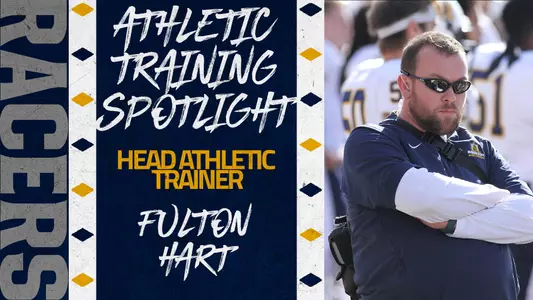
Athletic Training Spotlight: Fulton Hart
5/26/2020 8:54:00 AM | General
Fresh out of graduate school at Southeastern Louisiana University, Fulton Hart returned to his undergraduate alma mater in 2007 to begin his journey with the Murray State athletic training staff. A 2005 Murray State graduate in exercise science with an emphasis in athletic training, Hart then accepted a graduate assistant position at SLU where he went on to complete his master's in health studies. During that period, he also spent time as an athletic training intern with the New Orleans Saints. Now in his 13th year at Murray State, he holds the position of Head Athletic Trainer while serving as the primary contact for Racer football. He also oversees many of MSU's current athletic training graduate assistants.
Discussing the unique challenges of being an athletic trainer (AT) for the sport of football, exploring the day-to-day duties of an AT, and diving into what motivates him to be at the top of his game on game day are the topics for this week's MSU Athletic Training Spotlight.
In recent years, media has brought a lot of attention to the importance of limiting long-term effects of injuries. How has this impacted the approach of athletic trainers, especially in a sport like football?
"It hasn't really changed a whole lot of my approach because it's always been athlete-first for me. The importance of that next game is not nearly as important to me as it is for those guys to be able to toss the football around in the backyard with their kids someday. I want them to be able to do things down the road where they won't look back and think oh man, if I hadn't played that one game or if I hadn't come back too early…I don't want something like that where it affects their life and they're unable to do things they want to do down the road."
What's one thing that the everyday person might not know about the day-to-day responsibilities of an athletic trainer?
"Just the amount of time we spend with the athletes and the relationships we have with the athletes… As an athletic trainer, we get to spend more time with the athletes than really even the coaches do. The coaches are limited with their hours with athletes by the NCAA, and for us, we can be around them all the time, 24/7, every day of the week. So, I get to spend a lot of time with the athletes and I really get to develop relationships with those guys. We learn way more about them than we ever want to at times, because we're just a voice for them. We don't control their playing time, we don't control their scholarship dollars, we're just here and somebody they can talk to about things going on at home, things going on with their roommates or girlfriends – all that stuff. We're just a voice for them and somebody for them to talk to. Our relationships and how much time we get to spend with them is probably something people don't realize."
Athletic trainers make enormous contributions to the success of their teams. Just like players practice to improve their skills on the field, what drives you to be at the top of your game on game day?
"I think it goes back to that previous answer a little bit. It's the relationships. We do spend so much time with these guys and watching them invest their time into playing the sport of football. Football is one of those sports where you have 11 or 12 games a year but you spend literally every other day of the year preparing for those 12 games. We see how invested they are in those limited opportunities. Over the whole career of a football player, they play the number of games that most athletes play in one season. We see the time they invest, and I try to be at the top of my game to keep them healthy and to get them well to make sure it's safe for them to participate, but make sure they are able to participate in as many of those opportunities as possible because they are so limited."
Discussing the unique challenges of being an athletic trainer (AT) for the sport of football, exploring the day-to-day duties of an AT, and diving into what motivates him to be at the top of his game on game day are the topics for this week's MSU Athletic Training Spotlight.
In recent years, media has brought a lot of attention to the importance of limiting long-term effects of injuries. How has this impacted the approach of athletic trainers, especially in a sport like football?
"It hasn't really changed a whole lot of my approach because it's always been athlete-first for me. The importance of that next game is not nearly as important to me as it is for those guys to be able to toss the football around in the backyard with their kids someday. I want them to be able to do things down the road where they won't look back and think oh man, if I hadn't played that one game or if I hadn't come back too early…I don't want something like that where it affects their life and they're unable to do things they want to do down the road."
What's one thing that the everyday person might not know about the day-to-day responsibilities of an athletic trainer?
"Just the amount of time we spend with the athletes and the relationships we have with the athletes… As an athletic trainer, we get to spend more time with the athletes than really even the coaches do. The coaches are limited with their hours with athletes by the NCAA, and for us, we can be around them all the time, 24/7, every day of the week. So, I get to spend a lot of time with the athletes and I really get to develop relationships with those guys. We learn way more about them than we ever want to at times, because we're just a voice for them. We don't control their playing time, we don't control their scholarship dollars, we're just here and somebody they can talk to about things going on at home, things going on with their roommates or girlfriends – all that stuff. We're just a voice for them and somebody for them to talk to. Our relationships and how much time we get to spend with them is probably something people don't realize."
Athletic trainers make enormous contributions to the success of their teams. Just like players practice to improve their skills on the field, what drives you to be at the top of your game on game day?
"I think it goes back to that previous answer a little bit. It's the relationships. We do spend so much time with these guys and watching them invest their time into playing the sport of football. Football is one of those sports where you have 11 or 12 games a year but you spend literally every other day of the year preparing for those 12 games. We see how invested they are in those limited opportunities. Over the whole career of a football player, they play the number of games that most athletes play in one season. We see the time they invest, and I try to be at the top of my game to keep them healthy and to get them well to make sure it's safe for them to participate, but make sure they are able to participate in as many of those opportunities as possible because they are so limited."



Indiana State VS Murray State | MVC Baseball Tournament | Game Highlights
Friday, May 22
Evansville VS Murray State | Women's Basketball Game Highlights
Saturday, February 28
Head Coach Rechelle Turner | Racer Basketball | 2/26/26 Post Game Press Conference
Friday, February 27
Thomas & Pena | Racer Basketball | 2/26/26 Post Game Press Conference
Friday, February 27