Murray State University Athletics


I Know What You Did This Summer: MacKenzie Martin
6/19/2018 4:58:00 PM | Rifle
Rather than the lakes and hills of Western Kentucky or the waters of the Atlantic near her home in Massachusetts, this summer rifle student-athlete and engineering physics major Mackenzie Martin will spend time in the Black Hills of South Dakota or more accurately, under the Black Hills of South Dakota. In her own words, Martin tells GoRacers.com exactly what she is doing this summer.
____________________
 This summer, I am working at the Sanford Underground Research Facility (SURF) in Lead, South Dakota. This is a research experience for undergraduates (REU) put on through Black Hills State University. I am working at the heart of a collaboration called the LUX-Zeplin (LZ) Dark Matter experiment which 250 scientists from the United States, United Kingdom, Portugal, Russia and South Korea work in tandem on. This experiment is an attempt to detect Weakly Interacting Massive Particles, known as WIMPs, which are thought to be dark matter. Dark matter is one of the most pressing curiosities of particle physics. It is observed by its gravitational effects on galaxies and is believed to make up 80-percent of all mass in the universe, yet we don't know much of anything about it.
 Because this detector is so sensitive even a speck of dust can let off radiation, specifically from radon, that can ruin the experiments' accuracy. Radon has a half-life of 22 years, so if any was to touch the detector it would be a very long wait to continue the experiment. This brings me to my part in all of this, as I am in charge of maintaining high levels of cleanliness. I work in the Surface Lab at Sanford, as well as underground in the Black Hills Underground Campus (BHUC).
In the surface lab we have several clean rooms that have intensive protocols for entry; such as what can be brought in, how clean it must be, dust monitoring, and air pressure. In the reduced radon clean room (RCR), scientists and engineers work to build and test the Outer and Inner Cryostat Vessels for the device as shown in the pictures I have attached. These vessels are assembled and tested above ground before they are brought a mile underground. My job is to take slides from these clean rooms and photograph them microscopically to then run the images through a program and determine how much dust is getting through the radon reduce system and settling on surfaces. Also, I keep an eye on how much dust in the rooms by radon monitors. These monitors are inside each room and has a dust count based off what is passing through a lasers light when air is sucked through the machine.
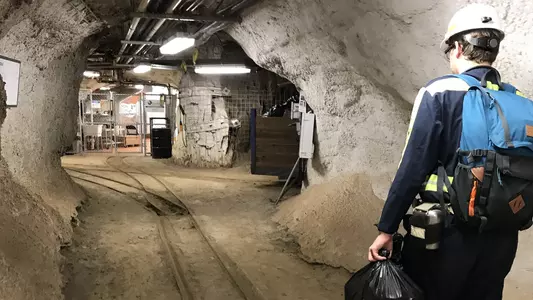
Another part of my job is going down to the BHUC, which is located a mile underground in an old mine shaft. In the BHUC, we bring different materials that might be used in the experiment and put them in low-background-counters which use germanium crystals, to determine what material will create less "background" in the experiment, background, meaning false positives or reactions that the detector will pick up and distract from the important data. This has to be done underground so that the detectors are not effected by cosmic radiation.
I've really enjoyed working with many different collaborators. It hasn't even been a month but being at the center of this project has put me in the path of many great minds. Each week, a different group of scientists and engineers from all over the world pass through this lab. Already, I have made many new connections with head engineers, professors from many universities and senior physicists. Last week, I worked under Pawel Majewski who is a physicist from the U.K., who worked on the design and creation of the cryostat vessels for five years. It's amazing to me that I am getting a front row seat to seeing their hard work come to fruition.
____________________
This summer, I am working at the Sanford Underground Research Facility (SURF) in Lead, South Dakota. This is a research experience for undergraduates (REU) put on through Black Hills State University. I am working at the heart of a collaboration called the LUX-Zeplin (LZ) Dark Matter experiment which 250 scientists from the United States, United Kingdom, Portugal, Russia and South Korea work in tandem on. This experiment is an attempt to detect Weakly Interacting Massive Particles, known as WIMPs, which are thought to be dark matter. Dark matter is one of the most pressing curiosities of particle physics. It is observed by its gravitational effects on galaxies and is believed to make up 80-percent of all mass in the universe, yet we don't know much of anything about it. Because this detector is so sensitive even a speck of dust can let off radiation, specifically from radon, that can ruin the experiments' accuracy. Radon has a half-life of 22 years, so if any was to touch the detector it would be a very long wait to continue the experiment. This brings me to my part in all of this, as I am in charge of maintaining high levels of cleanliness. I work in the Surface Lab at Sanford, as well as underground in the Black Hills Underground Campus (BHUC).In the surface lab we have several clean rooms that have intensive protocols for entry; such as what can be brought in, how clean it must be, dust monitoring, and air pressure. In the reduced radon clean room (RCR), scientists and engineers work to build and test the Outer and Inner Cryostat Vessels for the device as shown in the pictures I have attached. These vessels are assembled and tested above ground before they are brought a mile underground. My job is to take slides from these clean rooms and photograph them microscopically to then run the images through a program and determine how much dust is getting through the radon reduce system and settling on surfaces. Also, I keep an eye on how much dust in the rooms by radon monitors. These monitors are inside each room and has a dust count based off what is passing through a lasers light when air is sucked through the machine.
Another part of my job is going down to the BHUC, which is located a mile underground in an old mine shaft. In the BHUC, we bring different materials that might be used in the experiment and put them in low-background-counters which use germanium crystals, to determine what material will create less "background" in the experiment, background, meaning false positives or reactions that the detector will pick up and distract from the important data. This has to be done underground so that the detectors are not effected by cosmic radiation.
I've really enjoyed working with many different collaborators. It hasn't even been a month but being at the center of this project has put me in the path of many great minds. Each week, a different group of scientists and engineers from all over the world pass through this lab. Already, I have made many new connections with head engineers, professors from many universities and senior physicists. Last week, I worked under Pawel Majewski who is a physicist from the U.K., who worked on the design and creation of the cryostat vessels for five years. It's amazing to me that I am getting a front row seat to seeing their hard work come to fruition.
Indiana State VS Murray State | MVC Baseball Tournament | Game Highlights
Friday, May 22
Evansville VS Murray State | Women's Basketball Game Highlights
Saturday, February 28
Head Coach Rechelle Turner | Racer Basketball | 2/26/26 Post Game Press Conference
Friday, February 27
Thomas & Pena | Racer Basketball | 2/26/26 Post Game Press Conference
Friday, February 27